The small business field guide
How to write an estimate
Give the price before the work, so your client can say yes with nothing left to guess. Four steps, a worked estimate and a free estimate generator when you are ready.
Fill it in. Download the PDF. No sign-up.The quick answer
To write an estimate, say what the work includes and what it does not, give one price in dollars with labor and materials split, add the terms (dates, how long the price holds, the deposit and when the rest is due) and get your client’s written yes before you start. Send it, keep a copy, and turn it into your invoice when the work is done.
01 / Start here
Before you write your first estimate
An estimate answers three questions before the work starts. What will you do? What will it cost? What happens next?
It is the first paper in a job. Everything after it, from the deposit to the final invoice, starts from what it says. A clear estimate helps avoid disputes, because it is written when nobody is annoyed yet.
Before you write it, look at the job. Take photos, measure, and ask what the client wants done and by when. Write down what you saw. Then write the estimate from your notes, not from memory. The same job in this guide runs through five pages: this estimate, a change order, a progress invoice, the final invoice and a receipt.
Before the work
Estimate
Your price for the work, with the scope and the terms. Your client says yes or no.
Fixed or not
Quote or bid
Often a fixed price. No official US page we read defines the word, so say on the page whether your price is fixed.
Rules depend on where you work. This guide is written for the United States. Contractor rules differ by state, and some trades need a license. The examples teach the method. They are not legal or tax advice.
02 / The method
How to write an estimate in 4 steps
The four steps are always the same, for a one-day job or a three-month job. Each one stops a mistake you have probably seen.
- Scope What is in, what is out, which materials. Helps avoid “I thought that was included.”
- Price Dollars and cents, labor and materials split, one total. Helps avoid A surprise at the end.
- Terms Dates, how long the price holds, the deposit, when the rest is due. Helps avoid A price that never expires.
- Yes A written, dated yes before work starts. Helps avoid Work that starts without a written yes.
Never skip the yes. An estimate nobody approved is only a number.
-
Scope: say what is in the job and what is not
Walk the job and write down what you will do, room by room or task by task. Name the materials when the choice changes the price. Then write what is not included. The FTC says a written estimate should include a description of the work, the materials, the completion date and the price. [1]
Instead of: Paint the house
Write: Paint hallway walls, two coats, satin finish, color chosen by the client. Not included: ceilings, trim, repairs to damaged plaster.
An exclusion is not rude. It is the sentence that helps avoid an argument about the plaster in week two.
Helps avoid “I thought that was included.”
-
Price: put one price on it, in dollars and cents
Split labor from materials and name the unit: hours, gallons, square feet or a fixed amount for the job. Show the subtotal, any discount, any sales tax and one total. In this guide’s job, the hallway is 3.5 hr at $60.00 plus paint and supplies, and the whole estimate comes to $880.00.
Then say whether the price is fixed. People use “estimate” and “quote” in different ways, so write it out: “This price is fixed for the work listed. Anything else needs a written change.”
Estimate total = labor + materials − discount + sales tax
Sales tax depends on your state and on what you sell. The tax section of the invoice guide shows where to check. This guide’s example assumes none.
Helps avoid A surprise at the end, or a rough price taken as a promise.
-
Terms: set the dates, how long the price holds and the payments
Write the planned start and finish dates, how long the price holds (30 days is common), the deposit and when the rest is due. The FTC adds an estimated start and completion date to the list of what a contract should hold. [1] California requires a schedule of payments in dollars when you are paid before the job is done. [2] New York requires approximate start and completion dates in a home improvement contract. [3]
If you bill in stages, write the stages and the amount for each now. The progress invoice guide shows how they add up later.
Helps avoid A price that never expires, or a deposit nobody agreed to.
-
Yes: get your client’s written yes before the work starts
Ask your client to sign and date the estimate, or to approve it in writing in a way you can keep. A nod, a thumbs-up emoji or “sounds good” in a hallway is not a yes you can show anyone later.
In California, a home improvement contract and any change to it must be in writing and signed before the work starts. [2] New York requires a home improvement contract to be in writing and signed by all the parties. [3] Even where no such rule applies, the date of the yes is the date the price became agreed.
Keep the signed copy with the estimate and your records. [4]
Helps avoid Work that starts without a written yes, and a price nobody remembers agreeing to.
Never skip a written, dated yes. An estimate nobody approved is only a number.
Doing this job after job?
You write the estimate once. InvoiceWren lets you share it with your client, who approves it on their own page. When it is approved, the estimate becomes the job, and the invoice starts from the same lines.
03 / See it done
A complete estimate example
Here is the made-up painting job this whole set of guides follows: a hallway first, then a bedroom, for Alex Morgan. Two stages, a $20 agreed discount, and a $200 deposit to start. The estimate total is $880.00. To keep the focus on the method, this example assumes no sales tax applies.
EST-2026-014
Valid until Nov 27 2026
Scope and price
| Description | Qty | Rate | Amount |
|---|---|---|---|
| Stage 1: Hallway | |||
| Paint hallway walls · labor | 3.5 hr | $60.00 | $210.00 |
| Interior wall paint | 1 gal | $85.00 | $85.00 |
| Masking tape & protective supplies | 1 lot | $25.00 | $25.00 |
| Stage 1 subtotal | $320.00 | ||
| Stage 2: Bedroom | |||
| Prepare & paint bedroom walls · labor | 6 hr | $60.00 | $360.00 |
| Interior wall paint | 2 gal | $85.00 | $170.00 |
| Masking tape & protective supplies | 1 lot | $50.00 | $50.00 |
| Stage 2 subtotal | $580.00 |
Not included and approval
Not included: ceilings, trim and repairs to damaged plaster. Any other change needs a written change order before the work. To approve this estimate, sign and date: Approved by ______________ Date ____________
Made-up names, address and prices. Add your real details, your license number if your trade needs one, and anything your state requires.
Scope: two stages, with what is not included.
Price: labor and materials split, one total.
Terms: finish date, how long it holds, the deposit.
Discount: agreed up front, so it is not a later argument.
Deposit: an amount, with the balance shown.
Yes: a line to sign and date.
Skip the retyping
In InvoiceWren the approved estimate turns into an invoice with one tap. It copies the lines, taxes and client, and keeps the estimate, the deposit and the invoice together on one job.
04 / The deposit
How much deposit can you ask for?
A deposit covers materials and holds your date. Write the amount and when it is due on the estimate, so it is part of the yes. The FTC tells consumers not to pay the full amount up front, and says some states limit what a contractor can ask for as a down payment. 1
The limits are real and they differ. California says the down payment on a home improvement contract must not exceed $1,000 or 10 percent of the contract amount, whichever is less. 2 Florida sets no cap, but a residential contractor who takes more than 10 percent of the contract price as the first payment must apply for permits within 30 days and start the work within 90 days after the permits are issued. 5
The deposit in this guide is $200.00, which is 22.7% of $880.00. The example job is not in California. If it were, the most it could ask for is $88.00. Use the checker below with your own numbers, and tick the box to test the California limit.
Check your price and your deposit
Type your hours, rate and materials. The checker adds the estimate, shows the deposit as a share of it and, if you tick the box, tests it against California’s limit. It is a teaching aid, not legal advice.
Labor $570.00 + materials $330.00 − discount $20.00. The $200.00 deposit is 22.7% of the total, and $680.00 is due after it.
Take a deposit, then stop counting it. A deposit is not extra. It is part of the agreed price paid early, so it comes off the final invoice. Write on the estimate where it will be credited. The progress invoice guide shows how.
05 / Make yours
Make your estimate now
Use the same four steps with your own job. Add your lines, set how long the price holds and the deposit, then download the PDF. No sign-up, and what you type stays in this browser.
What the free estimate generator does
It makes a PDF estimate with your details, your lines, a valid-until date, a deposit of 25%, 50% or a set amount, and a line for your client to approve. It does not collect a signature for you: print it or sign the PDF. For a job billed in stages, name each stage in the lines.
Say who it's for
Everything you type stays in this browser. We never see it.
About you
About your client
20 free estimate designs to start from
Pick a design and the form above switches to it. Everything stays editable, and you can download it as a PDF.
-
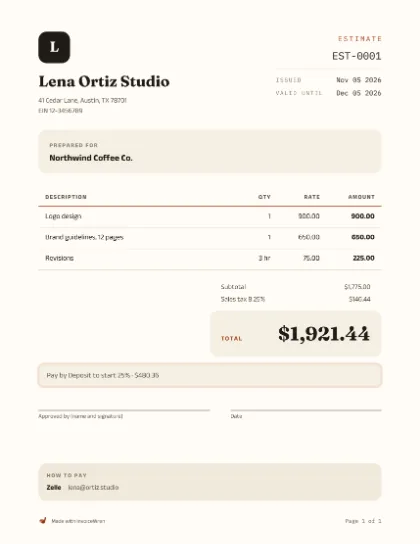
Plain
Everyday work
-
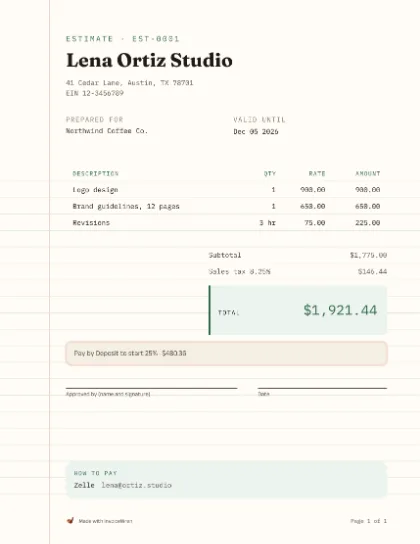
Ledger
Trades and repairs
-
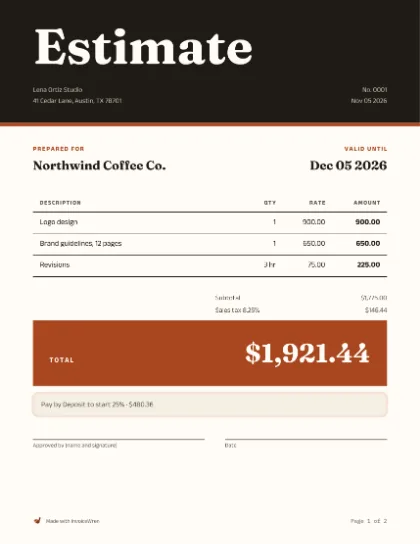
Bold
Studios and creative work
-
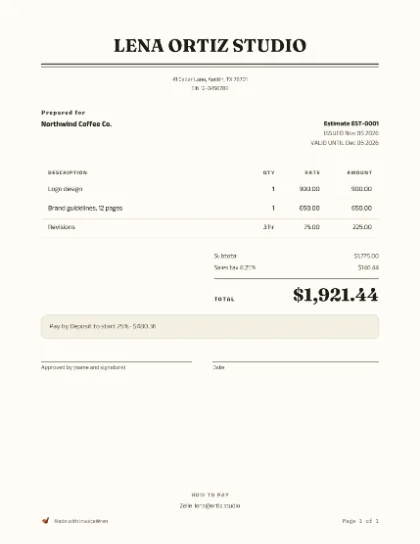
Letterhead
Consultants and offices
-
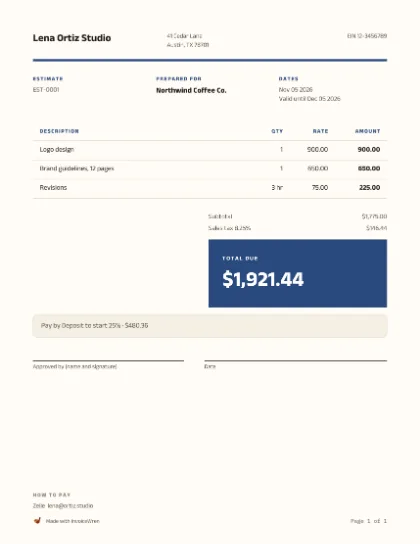
Grid
Agencies and developers
-
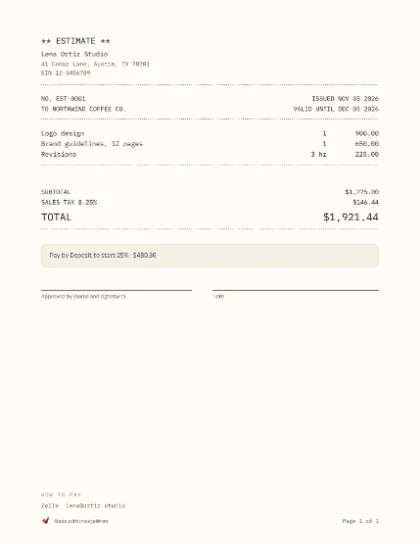
Mono
Makers and small shops
-
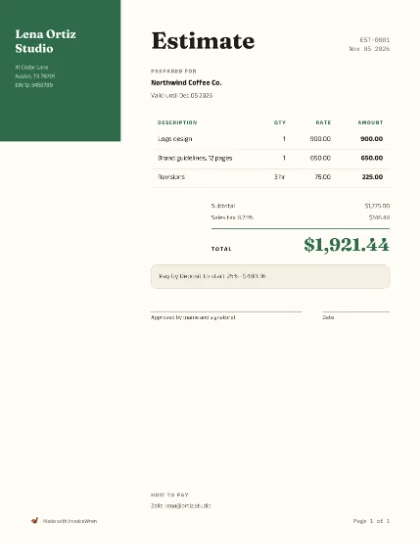
Side band
Photographers and events
-
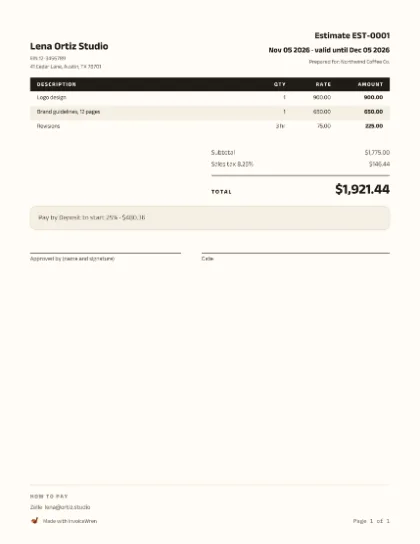
Compact
Long parts lists
-
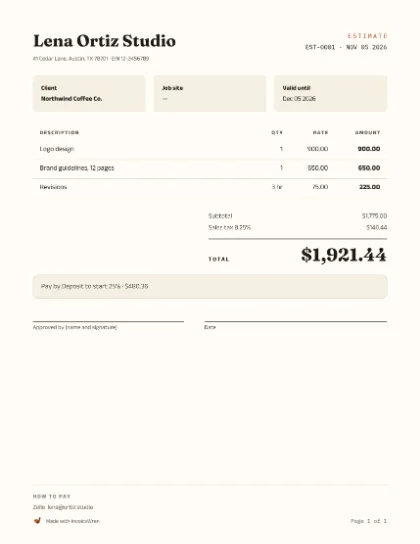
Contractor
Labor and materials
-
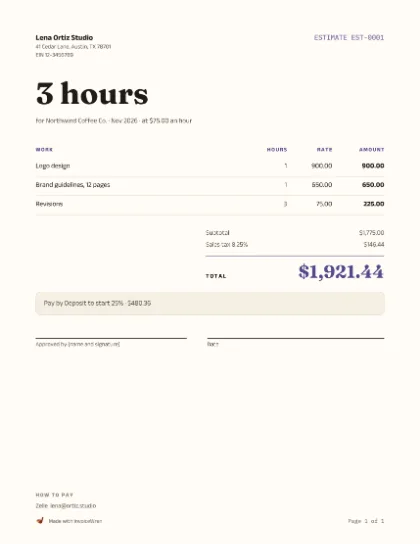
Hours
Billing by the hour
-
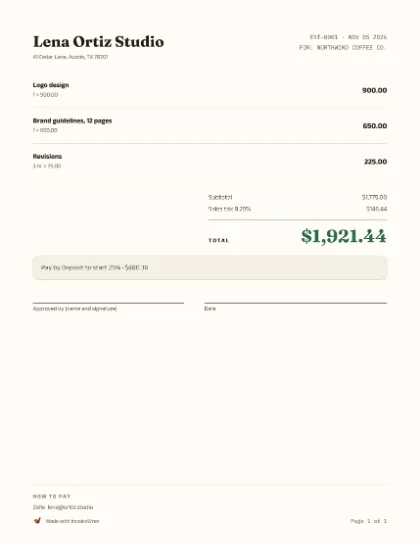
Photos
Show the work done
-
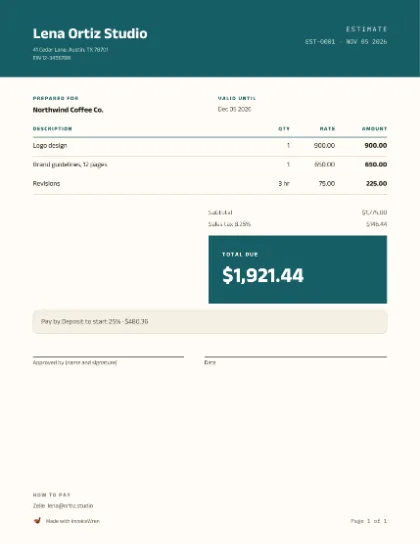
Banner
Salons and service shops
-
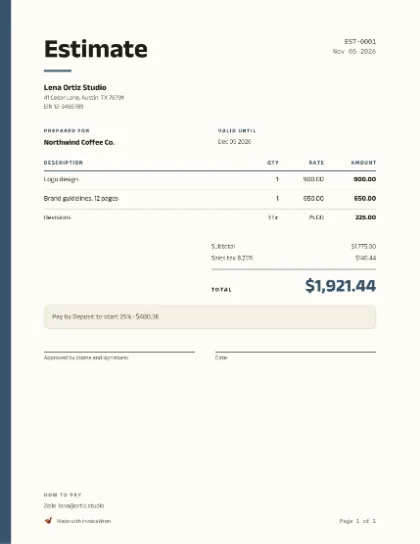
Stripe
Freelance projects
-
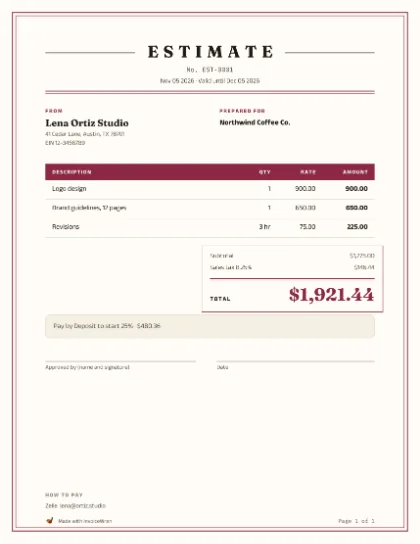
Classic
Law, accounting and formal firms
-
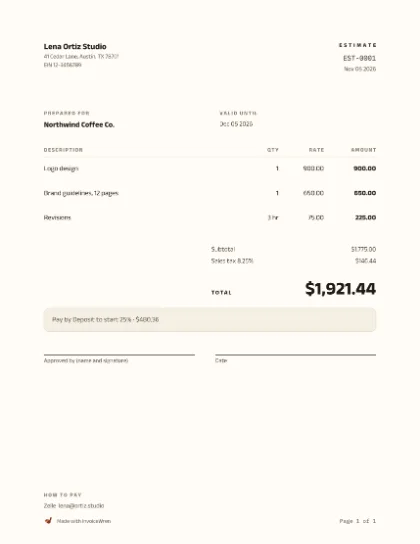
Minimal
Designers and writers
-
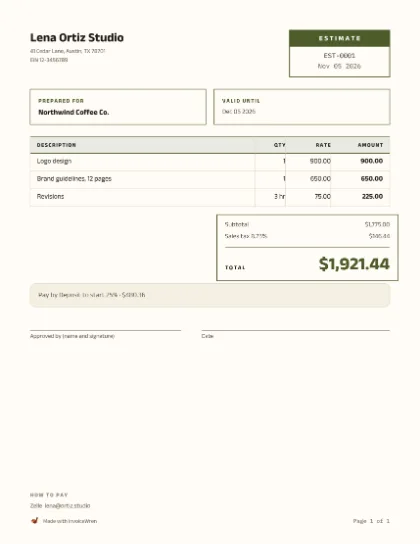
Boxed
Wholesale and parts counters
-
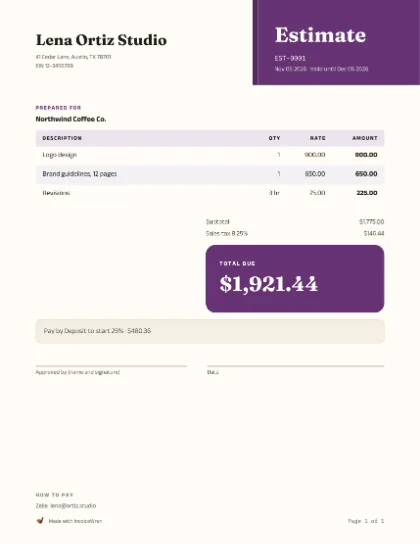
Corner
Shops and markets
-
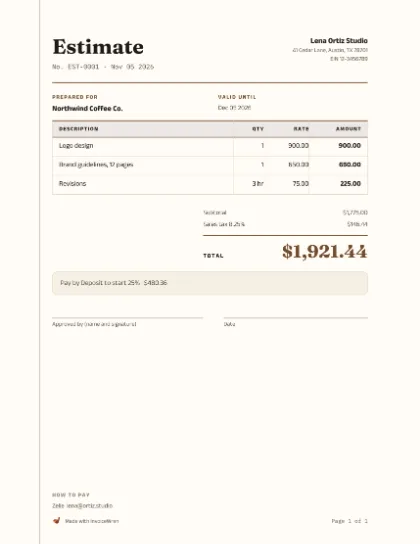
Journal
Bookkeepers and clubs
-
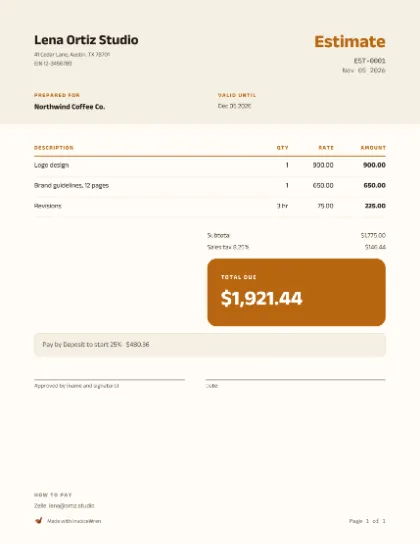
Duo
Cleaners and home services
-
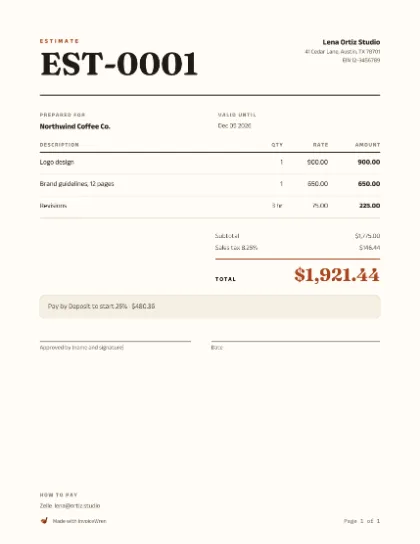
Editorial
Coaches and authors
06 / Rules by place
What the rules say about written estimates
There is no one US rule. The federal government gives advice, and the contract rules for home improvement come from the states. Here is what the pages we read say.
| Place | What it says |
|---|---|
| Federal (FTC advice) | A written estimate should include a description of the work, the materials, the completion date and the price. Contract requirements vary by state, and the FTC says to ask for a written agreement even if your state does not require one. [1] |
| California | A home improvement contract over $500 must be in writing, signed before work starts, and show the contract price and a description of the project. The down payment is limited to the lesser of $1,000 or 10% of the contract amount. [2] |
| New York | A home improvement contract and all amendments must be in writing and signed by all parties. It must show approximate start and substantial-completion dates. [3] |
| Florida | No down payment cap in the section we read. A residential contractor who takes more than 10% of the price first must apply for permits within 30 days and start within 90 days of the permits. [5] |
| Other states | Check your state’s contractor licensing board. Many states have their own contract and down payment rules. |
These are summaries of the pages we read, not a full checklist and not legal advice. Rules and limits change, so check the current official page before you issue a real estimate.
How other countries do it
Other countries use the words differently. In England, they do it this way.
| Country | How they do it |
|---|---|
| United Kingdom | In England, Citizens Advice tells people to get a quote, not an estimate. A quote is a fixed price. An estimate is a rough guess, so the person may pay more. A trader cannot charge more than the quote unless the customer asks for extra work or agrees to pay more. Get it in writing. [6] |
We left out Australia and India. We could not read an official page there about estimates, so we say nothing about them.
07 / When one estimate is not the whole job
From the first estimate to the final payment
The estimate is the first of several papers. InvoiceWren keeps them on one job, so each one starts from what was agreed.
- Send it, get a yesYour client reviews the estimate on their own page and approves it with a typed name and signature. You see who approved it and when.
- Estimate to invoiceWhen your client approves it, it becomes the job. The invoice starts from the same lines, so nothing is retyped.
- A deposit on the estimateAsk for an amount or a percentage. Your client taps “I’ve paid” and you confirm it. Nothing is marked paid by a click.
- Changes come nextA later change is a change order. It is never counted in the agreed total until your client says yes.
08 / Sending it
What to say when you send an estimate
Keep it short. Name the job, the price, the deposit, how long the price holds and how to say yes. Here is an original example you can change.
Hi Alex,
Thank you for letting me look at the hallway and the bedroom. Attached is estimate EST-2026-014.
The price is $880.00 for the work listed, after a $20.00 discount. A deposit of $200.00 starts the job. The price holds until Nov 27 2026.
To say yes, sign and date the approval line and send it back. I will not start until I have your yes.
If anything is unclear, reply to this email and I will go through it with you.
Thank you,
Oak & Brush Painting
If your client wants a change before they sign, change the estimate and send a new copy with a new date. Do not make the change by phone and keep the old paper.
09 / Last look
Check these before you send the estimate
Use this list on your real estimate. It catches the common slips. It is not legal advice.
Your ticks reset when you reload this page.
10 / Questions
Questions about writing an estimate
What is the difference between an estimate and a quote?
People use the two words in different ways, and we found no official US page that defines them. Many sellers say an estimate is a price that can move and a quote is a fixed price. In England, Citizens Advice puts it that way. [6] Do not rely on the word. Write one sentence on the document that says whether the price is fixed for the work listed.
Is an estimate legally binding?
It depends on where you work and on what both sides agreed to. Many online guides say flatly that an estimate is never binding. We could not find an official US source that says so. If your client signs it to go ahead, it may be treated as the agreement. In California, a home improvement contract over $500 must be in writing and signed before work starts. [2] Write an estimate as if it could be held against you.
How long should an estimate be valid?
Pick a period you can really keep your prices for. This guide’s example holds the price for 30 days, to Nov 27 2026. Put the date on the estimate. After it, you can write a new one without arguing about the old price.
How much deposit can I ask for?
It depends on your state. California limits the down payment on a home improvement contract to the lesser of $1,000 or 10% of the contract price. [2] In the section we read, Florida sets no cap, but a residential contractor who takes more than 10% as the first payment must apply for permits within 30 days and start work within 90 days after they are issued. [5] The FTC says some states limit a down payment. [1] Check your state first.
Do I need my client’s signature on an estimate?
Get a written yes, and make sure it shows the date. A signature is the clearest form. In California, a home improvement contract and any change to it must be in writing and signed before work starts. [2] In New York, a home improvement contract must be in writing and signed by all the parties. [3] If your contract is not covered by those rules, a written yes is still the best protection for both sides.
What if the job costs more than my estimate?
Do not just bill more. If the work changed, write a change order and get a yes before you do the extra work. If you made a mistake in your own price, the cost is usually yours. In England, a trader generally cannot charge more than a quote unless the customer asked for extra work or agreed to pay more. [6]
Should I charge for an estimate?
Many service businesses give free estimates for small jobs and charge for a detailed one that takes real time. Either is fine. If you charge, say so before you visit, and say whether the fee comes off the price if the client hires you.
What should an estimate for a small job include?
Who it is for, what you will do, what you will not do, the materials, one price with labor and materials split, the start and finish dates, how long the price holds, the deposit, when the rest is due and a line for your client to approve. The FTC lists the description of the work, the materials, the completion date and the price. [1]
Can I turn an estimate into an invoice?
Yes, and you should. Keep the same lines, subtract the deposit and bill only what the client agreed to. The how to make an invoice guide goes through it, and the progress invoice guide covers a job billed in stages.
Can I make an estimate for free?
Yes. The free estimate generator makes a PDF with your details, the lines, a valid-until date, a deposit and an approval line. There is no sign-up and no limit. Your client signs or approves it, and you keep a copy.
11 / Sources
Sources and further reading
Official guidance, checked on Nov 07 2026. The worked estimate, checker, message and checklist are original teaching examples. Check the current rules before you issue a real estimate.
- FTC — How To Avoid a Home Improvement ScamWhat a written estimate should include (description of the work, materials, completion date, price), that contract rules vary by state, and that some states limit a down payment. Page dated Jul 2022.
- California CSLB — License Law and Reference Book, 2026 edition (Business and Professions Code 7159 and 7159.5) and CSLB — What is a Contract?California’s rules for home improvement contracts over $500: in writing, signed before work starts, contract price and project description, and the down payment limit. The statute text is the board’s own PDF (the state’s statute site does not serve scripts). The second page is the board’s plain-English summary.
- New York General Business Law § 771 — Contract provisionsNew York’s rule that a home improvement contract and all amendments be in writing and signed by all parties, with approximate start and completion dates. The page shows the revision of Oct 29 2021.
- IRS — RecordkeepingKeep the records that support your income for as long as you need them to prove it on a return. Page reviewed May 01 2026.
- Florida Statutes 489.126 — Moneys received by contractorsFlorida’s permit and start deadlines for a residential contractor who takes more than 10 percent of the contract price as the first payment. 2025 statutes.
- Citizens Advice (England) — Before you get work done on your homeEngland: a quote is a fixed price, an estimate is a rough guess, and a trader cannot charge more than the quote unless the customer asks for extra work or agrees to pay more. Advice, not statute.
The job starts with a clear price.
Write the scope, the price, the terms and get the yes. Then download a PDF that is ready to send. Running bigger jobs with deposits and changes? Keep every step connected in the app.
Free tools and templates
Make the document this guide talks about. No sign-up.
More guides
- How to make an invoice
- How to Write a Change Order
- How to Make a Progress Invoice
- How to Make a Receipt
- What to include on an invoice
- How to number your invoices
- Best free invoice apps (2026)
- Change order template for a small remodel
- How to write a deposit invoice (with a worked example)
- Estimate vs invoice: what is the difference?
- How to set and word late fees
- A five-step schedule for late invoices
- Net 30 and other payment terms, explained
- Payment reminder messages you can copy
- Progress billing for contractors
- Taking deposits as a photographer
- What to do when a client will not pay
Invoice templates by trade
Sample lines and answers for each kind of work.
