Roofing Invoice Template
A clear invoice for every roofing job. Add the roof area, completed work, materials and approved extras, then download your PDF.
Say who it's for
Everything you type stays in this browser. We never see it.
About you
About your client
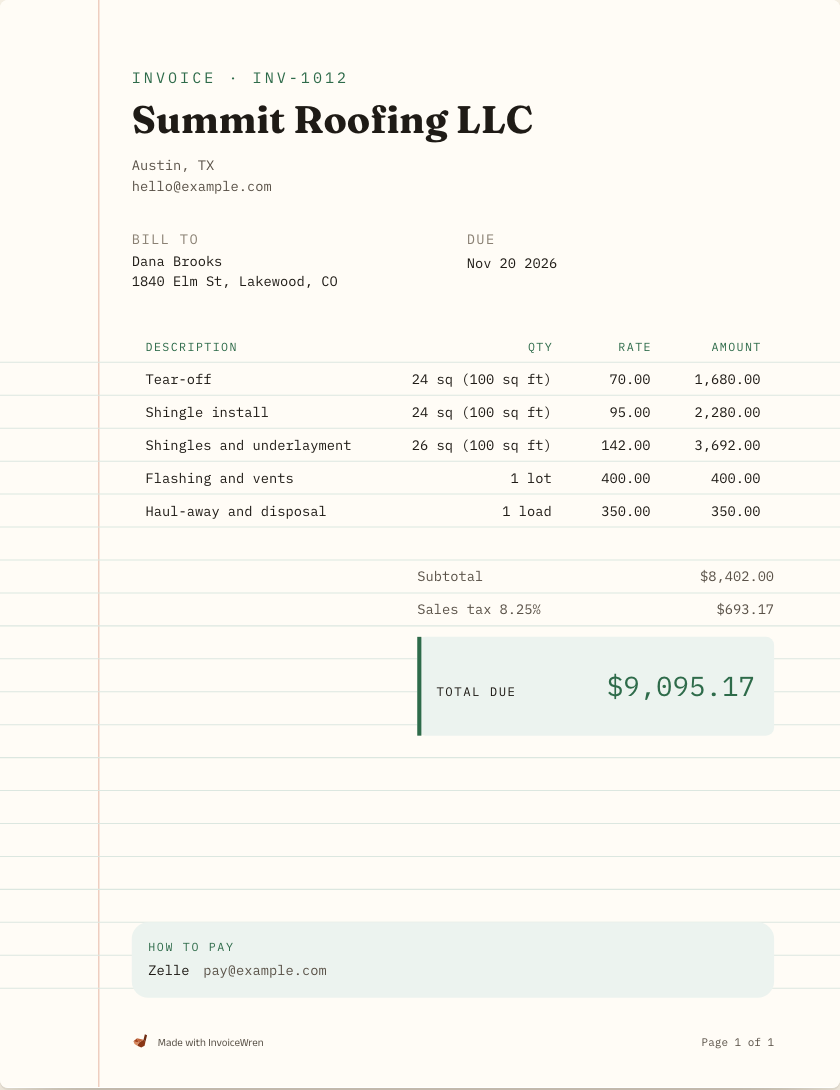
A sample roofing invoice
Example figures only. Set your own rates.
What roofing invoices commonly include
Tick off what you have put on your roofing invoice. Include what applies to your job. Ticks stay in this browser.
How roofers charge for roofing work
Roofing contractors commonly estimate replacement work by the roofing square, where one square equals 100 square feet of actual roof surface. Measure the roof planes and account for pitch, hips, valleys and other features. A roof's surface area is not necessarily the same as the building's floor area. Use the actual measurement and price agreed in the contract.
A replacement quote may include tearing off the existing roof, installing underlayment and new roofing, replacing required flashing and edge materials, and removing debris. Some contracts use one all-inclusive price, while others separately price labor, materials and additional services. Follow the accepted contract and do not bill twice for work already included in the agreed roofing price.
Roofing material orders can exceed the measured roof area because of trimming, cuts and waste. For example, a 24-square roof may require an order of 26 squares of shingles. Record the installed area separately from the material quantity purchased. Identify the actual roofing product, manufacturer, color and relevant specifications. Materials should not be described as installed merely because they were ordered.
Roof repairs are often billed at an agreed fixed price or an hourly rate for uncertain work. If damaged roof decking, flashing or other hidden problems are discovered during tear-off, document the finding and obtain the required approval before charging for additional work. Record replacement decking by actual quantity or area and reference the approved change on the invoice.
Roofing contracts may provide for deposits, progress payments and final payment. In Colorado, residential roofing contracts have specific written-contract, cancellation, deposit-handling and insurance-deductible requirements. Show earlier payments separately from the current amount due. For a Lakewood reroof, retain the permit reference and actual inspection status. Keep the manufacturer's roofing warranty distinct from the contractor's workmanship warranty.
Worked example
Questions people ask
What should a roofing invoice include?
Include your roofing business name, contact details, invoice number, invoice date, customer details and property address. Describe the completed roofing work, roof area, materials, agreed charges and any approved changes. Include applicable taxes, deposits or payments already applied, the amount due, due date and payment instructions. Record contractor registration and permit details where applicable, and reference the actual warranty documents.
What is a roofing square?
One roofing square equals 100 square feet of roof surface. A roof with 2,400 square feet of actual surface area has 24 roofing squares. Contractors use this unit for measurements, estimates and material quantities. Keep the installed roof area separate from any additional material ordered for cuts and waste.
How do I calculate roofing squares?
Measure the actual surface area of each roof plane, add the areas and divide the total square footage by 100. Account for slope, dormers and other roof features. The building footprint alone is not necessarily the correct roof area. Use verified measurements or the agreed roof takeoff rather than inventing a quantity.
Why might a roofer order 26 squares for a 24-square roof?
Additional material may be needed for cuts, roof valleys, hips, starter areas and other waste. For example, 26 squares ordered for a 24-square roof represents approximately 8.3 percent extra material. GAF discusses typical waste allowances of around 10 to 15 percent, depending on the roof. The correct allowance depends on the actual product and roof layout.
Should tear-off and installation appear on separate lines?
Follow the accepted contract. A fixed-price roof replacement may already include tear-off, underlayment, installation and disposal. Those services can be described without creating separate additional charges. If the agreement uses itemized or time-and-materials billing, show the agreed quantities and prices separately. Do not bill the same work twice.
Should roofing materials and labor be billed separately?
Use the pricing structure established by the underlying contract. A lump-sum agreement may cover labor and materials in one amount, while a time-and-materials agreement can separately price them. In Colorado, these arrangements can receive different sales-tax treatment. An invoice breakdown should not contradict the contract or automatically determine taxability.
How should I describe shingles on a roofing invoice?
Identify the actual manufacturer, product line, shingle type, color and quantity when available. Record the installed roofing area separately from the quantity ordered. Relevant supporting records may include product labels, delivery documents and installation information. Use the product actually installed rather than a generic description or an assumed brand.
How do I invoice a roof repair?
Describe the affected roof area, problem identified and repair actually completed. Apply the agreed fixed price or hourly labor and material rates. Identify significant supplied components and any separately approved diagnostic or access charges. Do not present a temporary repair as a complete roof replacement or a permanent solution unless that was the agreed and completed work.
How do I bill for damaged decking discovered during tear-off?
Document the damaged area and proposed replacement work. Record the required quantity, such as sheets of roof sheathing or square feet, and obtain approval under the contract's change procedure before billing the additional scope. Reference the approved change on the final invoice. Do not inflate the installed roofing-square measurement to hide separate decking work.
Does a roofing replacement require a permit in Lakewood, Colorado?
Yes. Lakewood's residential roofing guidance requires a building permit for re-roofing before work begins. Roof-covering repairs of less than 100 square feet are generally exempt, subject to applicable conditions and exceptions. The city requires contractors to hold the appropriate registration and identify the roofing material and number of squares in the permit application.
Does a roofing contractor need a license in Colorado?
Colorado does not have a general statewide roofing-contractor license equivalent to every local registration. Cities and counties may have their own requirements. Lakewood has a 5H roofing and waterproofing contractor registration classification. Record the relevant local credential and verify the rules for the actual project location.
How do roofing inspections work in Lakewood?
Lakewood's current residential roofing guidance uses uploaded photographic documentation for roof inspections. Contractors submit required photos through eTRAKiT and schedule the inspection. A final inspection is required, while some roofing systems require an additional mid-roof inspection. Record the actual result rather than assuming completion means the city approved the work.
Should the permit number appear on a roofing invoice?
Include the permit reference when one has been issued for the project. This helps identify the associated construction and inspection records. Keep actual government permit fees separate from contractor administrative charges when the agreement requires itemization. A permit number alone does not establish that the final inspection passed.
How do I invoice a roof replacement in stages?
Follow the signed contract's payment schedule. Identify the current milestone or completed work and distinguish the total contract price from the amount currently requested. Apply deposits and earlier payments correctly. For progress invoices, track earlier billings separately from cash received so unpaid amounts are not accidentally treated as paid.
Can a roofing contractor request a deposit in Colorado?
Colorado residential roofing contracts may provide for deposits, but the contractor must comply with the applicable written-contract, cancellation and payment-handling requirements. The contract must include prescribed cancellation and refund terms and a statement addressing how homeowner payments are held in trust before specified material-delivery or work-performance conditions. An invoice cannot replace those contract requirements.
Can homeowners cancel a Colorado roofing contract?
Colorado residential roofing law requires a contract provision allowing rescission within 72 hours after entering the contract. A separate statutory cancellation right applies in qualifying insurance-funded projects after notification that the insurer denied the claim in whole or in part, subject to exceptions. The actual cancellation procedure and refund obligations depend on the circumstances and law. An ordinary invoice is not a substitute for the required contract language.
Can a Colorado roofer waive an insurance deductible?
No. Colorado Revised Statutes section 6-22-105 prohibits roofing contractors working on covered residential insurance-funded projects from promising to pay, waive or rebate any part of the applicable insurance deductible. An insurance deductible should not be entered as a contractor-funded promotional credit to disguise its waiver. Keep legitimate discounts, insurer payments and customer payments properly documented.
How should I invoice insurance-funded roof repairs?
Invoice the actual contracted roofing work and properly approved additional scope. Keep the contractor invoice separate from the insurer's claim estimate and claim-payment records. Record amounts actually received and the remaining customer balance accurately. Do not represent an insurer's proposed payment as money already received, waive a prohibited deductible or claim to be a licensed public adjuster without the required authority.
What if the insurer approves additional roofing work later?
Document the additional roofing scope and price through the applicable contract approval process. An insurer's supplemental estimate is not automatically proof that the homeowner approved every additional charge. Reference the approved work separately, update the invoice when appropriate and maintain the relationship to the original contract and previous billings.
Do roofing contractors charge sales tax in Colorado?
Colorado applies different tax rules to qualifying construction and building materials depending on the underlying contract. Under a lump-sum construction contract, the contractor generally pays tax when purchasing incorporated materials and does not separately collect customer sales tax on the construction charge. Under a qualifying time-and-materials contract, the contractor generally collects sales tax on the separately sold materials, while construction labor is treated differently. State, local and permit-related use-tax rules may also apply.
How should I charge for dumpster rental and roofing disposal?
Follow the accepted estimate. Tear-off and disposal may already be included in an all-inclusive roof replacement price. If separately agreed, describe the actual dumpster, hauling or disposal service. Do not add disposal a second time when it was included in the contracted price.
What warranty information belongs on a roofing invoice?
Identify the installed roofing product and refer to the applicable manufacturer warranty and any separate contractor workmanship warranty. Record the actual coverage, effective date, duration and exclusions in the connected warranty documents. Some enhanced manufacturer roofing-system warranties include workmanship coverage, but eligibility and terms vary. Do not invent a universal warranty period.
Does a manufacturer's shingle warranty cover roofing labor?
It depends on the specific warranty and claim. GAF, for example, offers warranty tiers with different coverage for manufacturing defects, labor, tear-off and workmanship. Some enhanced warranties include installation-related protection under defined conditions. Check the actual product and warranty rather than assuming every shingle warranty covers all repair labor.
What if the roof fails the final inspection?
Record the actual inspection result and any corrective work required. Do not mark the job as passed or issue an approval claim that the building department has not made. Follow the contract and applicable law to determine responsibility for corrective work and any payment implications. If new separately chargeable work is proposed, follow the required approval process.
When should a roofing customer pay the final invoice?
Use the payment requirements in the signed contract and applicable law. The agreement may tie payment to completion, a milestone, an inspection or another event. Show the full agreed charges, approved additions, deposits, payments received and balance due. Do not assume all roofing jobs have the same final-payment condition.
Get it as a file
These open our general invoice templates. They are not pre-filled with roofing items. For a PDF with your roofing lines, fill in the form above.
Quoting the job first? Use the estimate generator. Want a different look? Try the invoice builder. New to invoicing? Read how to make an invoice, what to include on an invoice and how to number your invoices.
Related trades
Other invoice templates you may need.