Contractor Invoice Template
A clear bill for the work you've completed. Add the job address, work items, approved extras and payment terms, then download your PDF.
Say who it's for
Everything you type stays in this browser. We never see it.
About you
About your client
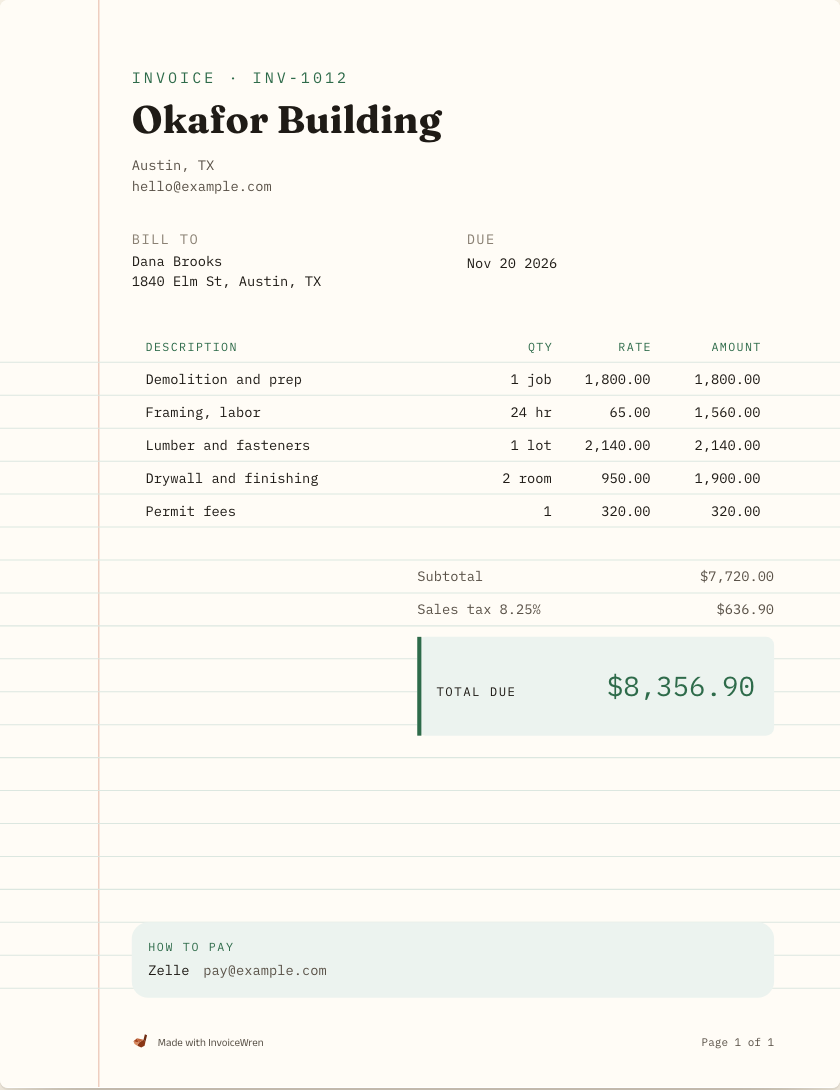
A sample contractor invoice
Example figures only. Set your own rates.
What to list on a contractor invoice
Tick off what you have put on your contractor invoice. Include what applies to your job. Ticks stay in this browser.
How contractors bill for construction work
For a fixed-price contract, agree on the total job price and any payment milestones before work begins. Bill according to the contract, whether that means a deposit, completed stages or a final payment. A progress invoice should identify the stage being billed and distinguish the current amount from earlier billings.
For time-and-materials work, bill the agreed labor rates for recorded hours and charge for materials according to the contract. Show dates, hours, quantities and agreed rates. Keep timesheets, receipts and delivery records available when the contract requires supporting documentation.
For cost-plus work, charge the reimbursable costs defined in the contract and add the agreed contractor fee or markup. Check whether the fee is a fixed amount or percentage, which costs qualify, and whether a guaranteed maximum price applies. Do not assume every expense or subcontractor charge is automatically reimbursable.
For staged construction jobs, track the original contract value, approved change orders, work completed to date, previous billings and any retainage. Record deposits and payments received separately. Show the current amount requested without charging twice for work included in an earlier invoice.
When work changes, document the revised scope, price and any schedule impact using the approval or change procedure in the contract. Reference the approved change on the invoice. Follow the contract's treatment of labor, materials, subcontractors and taxes rather than assuming every construction invoice uses the same breakdown.
Contract types
- Fixed price
- A total job price with agreed milestones. A progress invoice names the stage billed and separates the current amount from earlier billings.
- Time and materials
- Agreed labor rates for recorded hours, plus materials as the contract says. Show dates, hours, quantities and rates.
- Cost-plus
- The reimbursable costs the contract defines, plus the agreed fee or markup. Check which costs qualify and whether a guaranteed maximum price applies.
Questions people ask
What should a contractor invoice include?
Include your business name and contact details, invoice number, invoice date, client details and job-site address. Add the project or contract reference, work performed, quantities, rates and applicable taxes. Show approved extras, previous payments or deposits applied, any retainage, the balance due, due date and payment instructions. Include a license, registration or permit number when applicable.
How do I invoice a construction job in stages?
Follow the payment stages agreed in the contract. Identify the stage or billing period, the value of work completed, amounts previously billed and the current payment request. For projects using retainage or a schedule of values, include the relevant adjustments. Keep the project total separate from what is due on the current invoice.
Should contractors separate labor and materials?
Use the breakdown required by the contract. Separate labor and materials when the agreed pricing structure calls for it, but do not assume that itemizing an invoice changes a lump-sum contract into a separated contract. Tax treatment may depend on the original agreement, property type and jurisdiction.
How do I bill for time and materials?
Record the hours worked, the dates, labor rates and materials supplied. Apply the rates, reimbursements and markups agreed in the contract. Attach or retain supporting timesheets, receipts and delivery records when required. Check any agreed spending limit before billing additional costs.
How do I invoice a cost-plus construction job?
List costs that qualify for reimbursement under the contract, then calculate the agreed contractor fee. That fee might be fixed or calculated using an agreed percentage. Keep supporting records, check exclusions and follow any guaranteed maximum price or approval requirements.
How do I handle construction change orders?
Record the changed work, its price impact and any effect on the completion date. Follow the contract's required authorization process. When a change is approved for billing, reference its change-order number or approval record on the invoice. Do not treat an unapproved proposal as an ordinary completed charge.
What is retainage on a contractor invoice?
Retainage is money withheld from a progress payment and released under the applicable contract and legal rules. If retainage applies, show the amount retained and the current payment request separately. Do not assume the same retainage percentage or release date applies to every construction project.
Can I charge separately for subcontractors and permits?
Yes, when the contract allows those charges to be billed separately. Identify the subcontracted work and the applicable stage or scope. For permit reimbursements, retain the permit and fee records and avoid charging the customer twice for a fee already included in the agreed contract price.
Do contractors charge sales tax on materials and labor?
Rules vary by jurisdiction, contract type and work performed. For example, Texas generally treats new construction and residential remodeling differently from taxable nonresidential repair or remodeling. A qualifying lump-sum contract also has different material-tax treatment from a separated contract. Confirm the applicable rules before applying tax.
Does a general contractor need a license number on an invoice?
Include a contractor license or registration number if one is required or relevant to the work. Requirements depend on location and trade. For example, Texas does not require a state general-contractor license, although Austin requires registration for general contractors assigned to building permits and certain specialized trades require licenses.
When is payment due on a contractor invoice?
Use the payment schedule in the contract and comply with applicable law. Payment may be tied to a milestone, approved payment application or another agreed event. For example, Texas has statutory prompt-payment provisions for qualifying construction payment requests, with exceptions. Do not assume that a generic Net 14 term overrides those requirements.
Is a paid contractor invoice the same as a lien waiver?
No. A paid invoice records billing and payment information, while a lien waiver or release is a separate legal document. Some jurisdictions prescribe specific forms and conditions for lien waivers. In Texas, an unconditional waiver generally cannot be required before the covered payment has actually been received.
Can I invoice for materials delivered but not yet installed?
Only when the contract and applicable payment rules allow it. Some construction payment applications account for suitably stored materials. Identify the materials and follow any requirements for storage, ownership, insurance or supporting evidence. Do not automatically bill every material purchase as completed construction work.
Get it as a file
These open our general invoice templates. They are not pre-filled with contractor items. For a PDF with your contractor lines, fill in the form above.
Quoting the job first? Use the estimate generator. Want a different look? Try the invoice builder. New to invoicing? Read how to make an invoice, what to include on an invoice and how to number your invoices.
Related trades
Other invoice templates you may need.