The small business field guide
How to make a progress invoice
A progress invoice, also called a partial invoice, bills one stage of a job. Four steps to bill it, subtract what was paid and show what is left. A worked example and a checker are on the page.
Fill it in. Download the PDF. No sign-up.The quick answer
To make a progress invoice, which is also called a partial invoice, follow the agreed schedule of stages, bill only the stage that is done, take off the deposit and every earlier invoice once, and show the balance that is left to bill. Name the stage and its date on the invoice, and add the due date and how to pay. Check that the invoices never add up to more than the agreed total.
01 / Start here
Before you make your first progress invoice
One agreed price can be billed in more than one invoice. Your client should be able to answer three questions on each one. What is this for? What have I already paid? What is left?
A short job needs one invoice. A longer one, or one where you buy materials first, is easier to carry if you bill it in stages. You are not charging extra. You are splitting one agreed price into parts, and each part has to add up to that price, no more.
This guide follows one job: the hallway and bedroom painting from the estimate guide, with the change order that added a plaster repair. The hallway is billed first. The bedroom is billed last, in the final invoice.
These names all point to the same family of invoices:
| Invoice | When | What it bills | What it subtracts |
|---|---|---|---|
| Deposit invoice | Before the work starts | Part of the price, up front | Nothing |
| Progress, partial or stage invoice | When a stage is finished | The work done in that stage | Any earlier invoice, and the deposit if the contract says so |
| Final invoice | When the job is done | What is left of the agreed total | The deposit and every earlier invoice |
Before the work
Estimate
Holds the stages, the amounts and where the deposit is credited. See how to write an estimate.
During the job
Change order
Changes the agreed total. Only an approved change is billed. See how to write a change order.
Each stage
Progress invoice
Bills one finished stage and shows what is left. Make one below.
Rules depend on where you work. This guide is written for the United States. Down payment limits, progress payment rules and payment deadlines differ by state. The examples teach the method. They are not legal or tax advice.
02 / The method
How to make a progress invoice in 4 steps
The four steps are the same for the first stage and the last. The hard one is the third.
- Schedule Agree each stage and its amount, in dollars, before work starts. Helps avoid Billing without a plan.
- Evidence Bill only work that is done. Name the stage and its date. Helps avoid Billing ahead of the work.
- Subtract Take off the deposit and each earlier invoice, once. Helps avoid Charging the deposit twice.
- Balance Show this invoice, and what is left to bill. Helps avoid A client who cannot see the rest.
Never skip the subtraction. Take off the deposit and every earlier invoice, once.
-
Schedule: agree the stages and their amounts before the work starts
Write each stage, what it covers and its amount in dollars in the estimate. Say where the deposit and any discount will be credited. California asks for this when a contractor is paid before the job is done: a schedule of payments in dollars, each one referring to the work to be done and the materials to be supplied. [1] New York asks for the amount of each payment in dollars and the state of completion it follows. [2]
In this guide’s job, stage 1 is the hallway at $320.00 and stage 2 is the bedroom at $580.00. The $20.00 agreed discount and the $200.00 deposit are both credited on the final invoice.
Instead of: Pay in thirds
Write: Stage 1, hallway, when finished: $320.00. Stage 2, bedroom, when finished: $580.00. The $200.00 deposit and the $20.00 discount come off the final invoice.
Helps avoid Billing without a plan, and a client who cannot see what is coming.
-
Evidence: bill only the work that is done
Send a progress invoice when a stage is finished, and name the stage and the date it was finished. A progress invoice is a request for payment for work done, not an advance. California says that, apart from a down payment, a contractor may neither request nor accept payment that exceeds the value of the work performed or material delivered. [1] New York says progress payments must bear a reasonable relationship to the work, materials or expenses at the time of payment. [2]
The standard payment forms for large jobs track the same idea: for each line of the schedule of values, the work completed before, the work completed this period and the balance to finish. [3]
Instead of: Progress payment
Write: Stage 1, paint hallway walls, finished Nov 03 2026
Helps avoid Billing ahead of the work.
-
Subtract: take off the deposit and every earlier invoice, once
This is the step that goes wrong most. Before you total an invoice, list what the client has already paid or been billed on this job: the deposit, and each earlier progress invoice. Then take each off one time. The standard payment forms do the same: the contract sum to date, less previous certificates for payment, gives the current payment due. [3]
A list of earlier invoices does not prove they were paid. Check the payments, not the invoice list. In this guide’s job, INV-2026-001 was paid on Nov 05 2026, and the deposit was paid on Nov 01 2026.
Balance due on the final invoice = agreed total − deposit − earlier invoices
Helps avoid Charging the deposit twice.
Never skip the subtraction. A client who is billed a deposit twice stops trusting every number after it.
-
Balance: show what this invoice asks and what is left
At the foot of each progress invoice, show three numbers: the agreed total, what this invoice asks for, and what is left to bill. The standard forms call the last one the balance to finish. [3] Add the due date and how to pay.
A client who can see what is left is less likely to dispute a stage, because there is nothing to guess about the rest of the job.
Helps avoid A client who cannot tell what is still to come.
Billing in stages, job after job?
InvoiceWren keeps the estimate, the deposit and every stage on one job. Each progress invoice shows the agreed total, what was billed before, this invoice and what is left, so the adding up is done for you.
03 / See it done
A complete progress invoice example
Here is the first invoice of the made-up painting job: stage 1, the hallway, finished Nov 03 2026. It bills $320.00. The $200 deposit paid on Nov 01 2026 is not taken off this invoice, because the estimate says it is credited on the final one. To keep the focus on the method, this example assumes no sales tax applies.
INV-2026-001
Stage 1 of 2 · Currency: USD
Stage 1: Hallway, finished
| Description | Qty | Rate | Amount |
|---|---|---|---|
| Paint hallway walls · labor | 3.5 hr | $60.00 | $210.00 |
| Interior wall paint | 1 gal | $85.00 | $85.00 |
| Masking tape & protective supplies | 1 lot | $25.00 | $25.00 |
| Stage 1 total | $320.00 |
Where the job stands
- Agreed total (estimate EST-2026-014)
- $880.00
- Billed on earlier invoices
- $0.00
- This invoice (stage 1, hallway)
- $320.00
- Left to bill after this invoice
- $560.00
- Deposit paid Nov 01 2026, credited on the final invoice
- $200.00
- Agreed discount, credited on the final invoice
- $20.00
Payment instructions
Pay by Zelle or bank transfer using the details you were given. Use INV-2026-001 as the reference. Thank you for your business.
Made-up names, address and prices. Add your real payment details and anything your state requires.
Stage: named, with the date it was finished.
Agreed total: the number every stage adds up to.
This invoice: only the finished work.
Left to bill: what the client can expect next.
Deposit: shown, and credited once, where the estimate says.
Reference: one invoice, one unique ID.
04 / Closing the job
How the final invoice subtracts everything
The last invoice does the subtraction. The bedroom is finished, and CO-001 added $120.00 for the plaster repair. The agreed total is now $1,000.00. Here is how INV-2026-002 gets its balance. It is the invoice on the how to make an invoice page.
| Line | Amount |
|---|---|
| Agreed total (estimate $880.00 + CO-001 $120.00) | $1,000.00 |
| Deposit paid Nov 01 2026 | −$200.00 |
| Progress invoice INV-2026-001, paid Nov 05 2026 | −$320.00 |
| Final invoice INV-2026-002: balance due | $480.00 |
Check it by adding the other way: $200.00 + $320.00 + $480.00 = $1,000.00. The client has paid or been billed for the agreed total, once.
Skip the adding up
In InvoiceWren the final invoice is built from the agreed items with a reconciliation: the original estimate, each approved change, the deposit received and every earlier invoice. A change amount is never added twice, and a pending change is never billed.
05 / Check yours
Check that your stages add up
Before you send a progress invoice, add the deposit, the earlier invoices and this one, and compare them with the agreed total. The checker does it. Over the total is a warning, because the usual fix is a change order, not a smaller bill.
Will this invoice go past the agreed total?
Type the agreed total and what has been paid or billed so far. The default is this guide’s job at the final invoice. It is a teaching aid with whole cents, not legal advice.
Deposit $200.00 + earlier invoices $320.00 + this invoice $480.00 = $1,000.00 of $1,000.00 (100.0%).
Do not count a deposit twice. The $200 deposit lowers what is still owed. It does not lower the agreed price of the work. Credit it on one invoice, say which, and keep to it.
06 / Make yours
Make your invoice now
Use the same four steps with your own job. Name the stage in each line, add the due date and download the PDF. No sign-up, and what you type stays in this browser.
What the free invoice generator does
It makes a normal invoice PDF with your details, your lines, a discount, tax, a due date and your payment details. It has no stage fields and no “payments received” row. To make a stage invoice, name the stage in each line. To take a deposit off a final invoice, add a line with a minus amount, such as “Deposit received Nov 01 2026” at −200, so the total goes down.
Say who it's for
Everything you type stays in this browser. We never see it.
About you
About your client
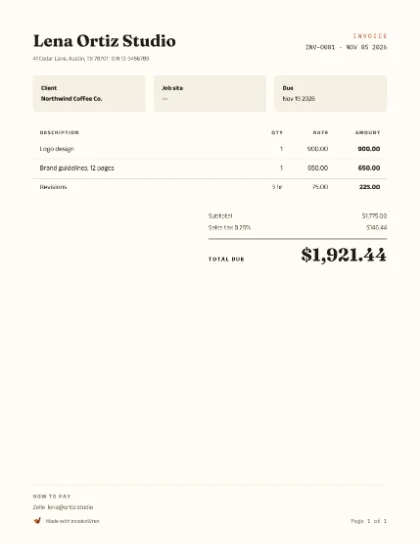
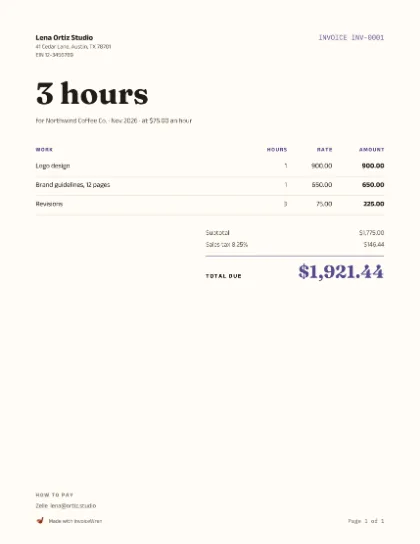
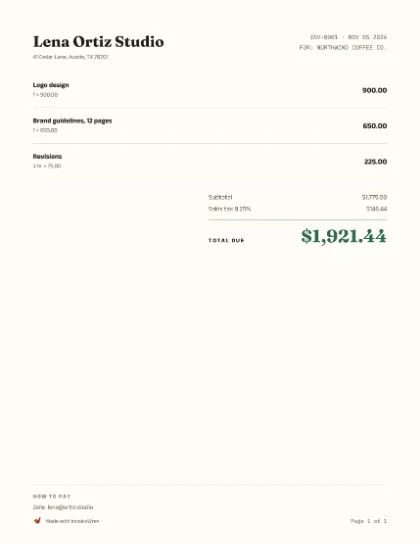
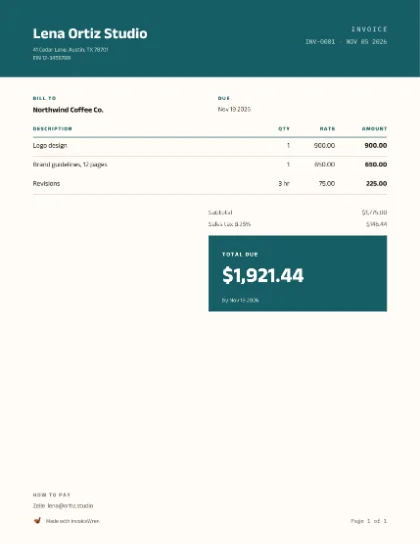
20 free invoice designs to start from
Pick a design and the form above switches to it. Everything stays editable, and you can download it as a PDF.
-
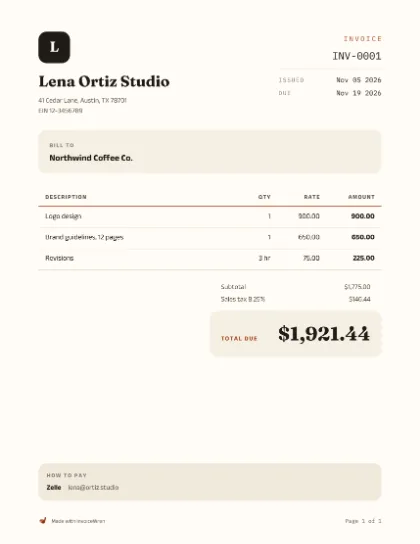
Plain
Everyday work
-
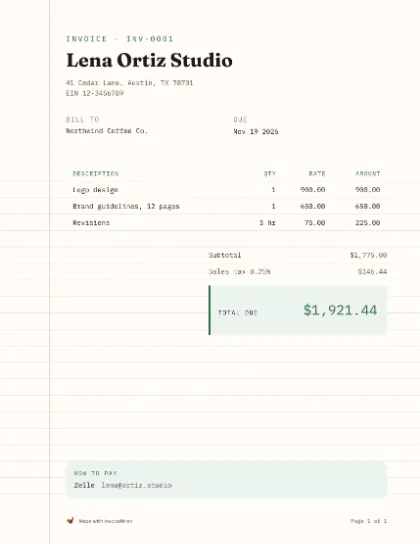
Ledger
Trades and repairs
-
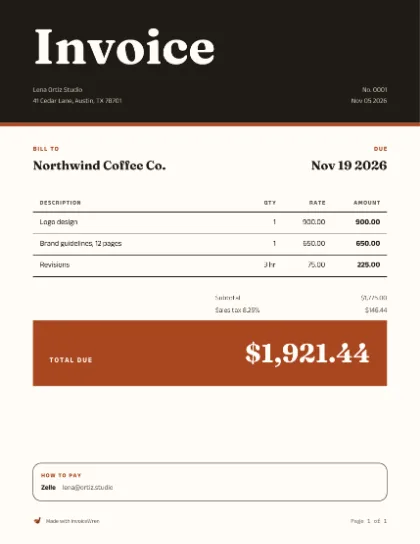
Bold
Studios and creative work
-
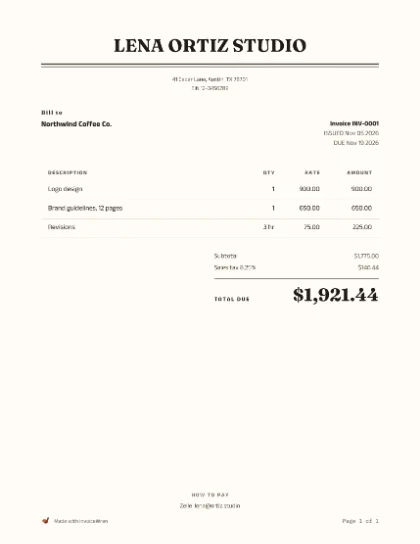
Letterhead
Consultants and offices
-
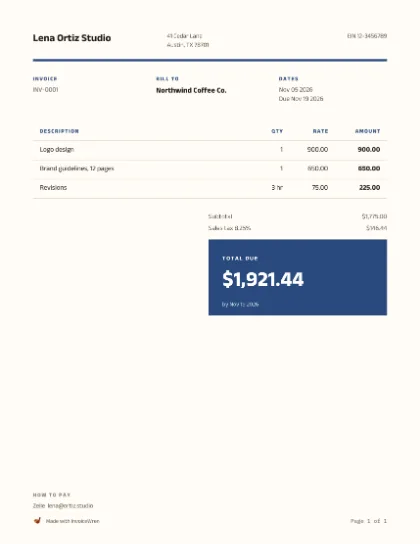
Grid
Agencies and developers
-
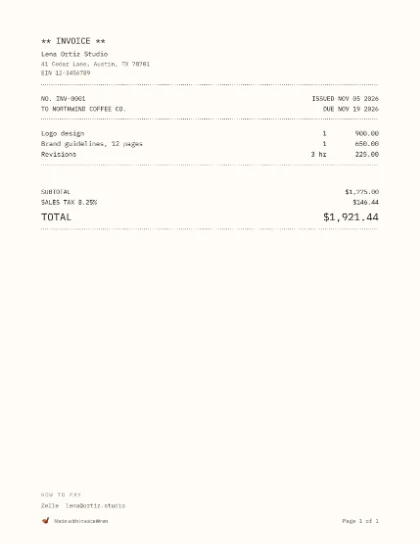
Mono
Makers and small shops
-
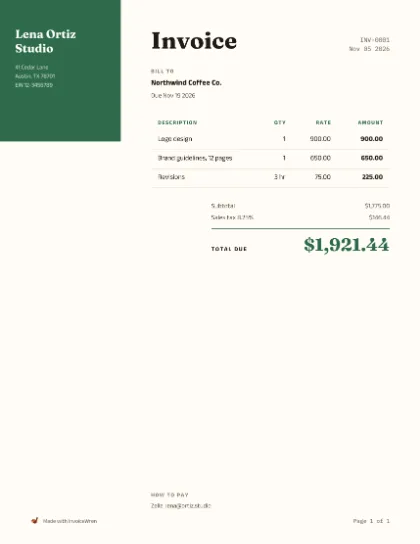
Side band
Photographers and events
-
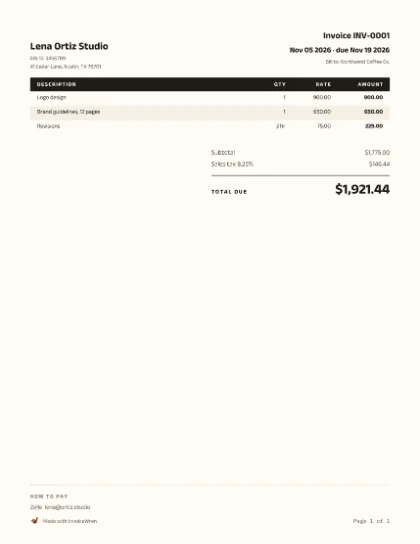
Compact
Long parts lists
-
Contractor
Labor and materials
-
Hours
Billing by the hour
-
Photos
Show the work done
-
Banner
Salons and service shops
-
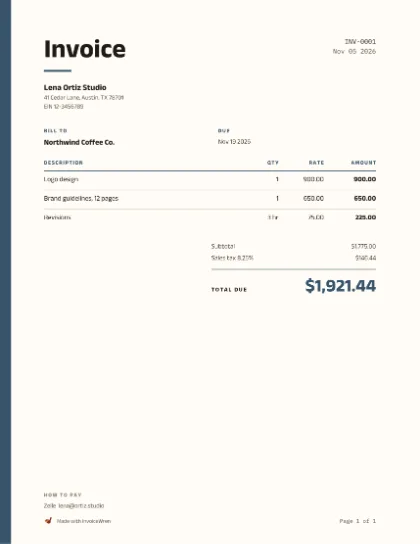
Stripe
Freelance projects
-
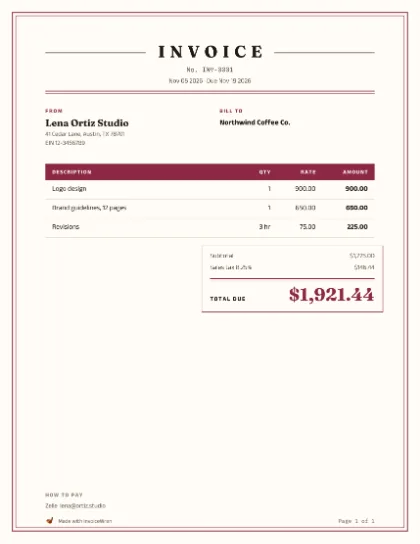
Classic
Law, accounting and formal firms
-
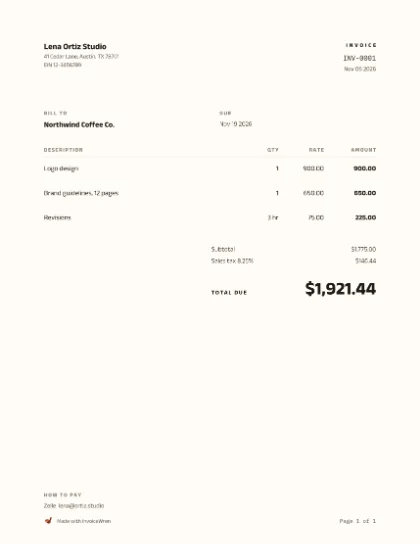
Minimal
Designers and writers
-
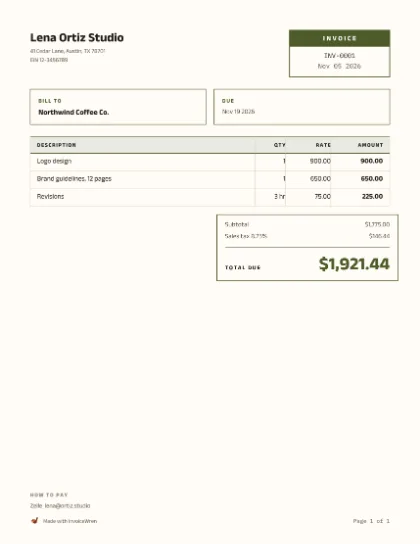
Boxed
Wholesale and parts counters
-
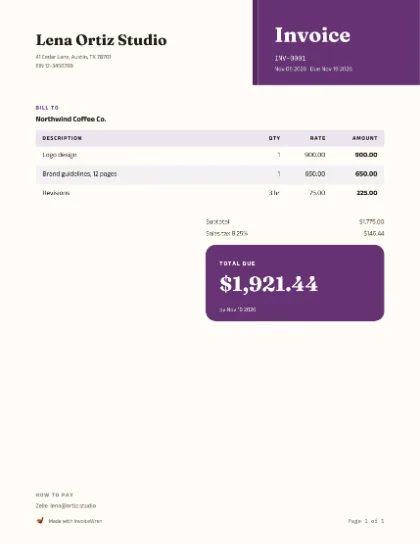
Corner
Shops and markets
-
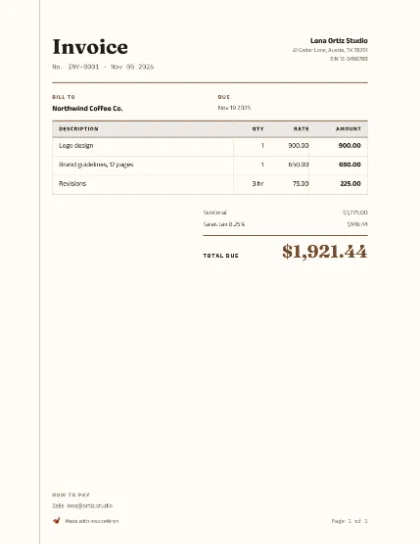
Journal
Bookkeepers and clubs
-
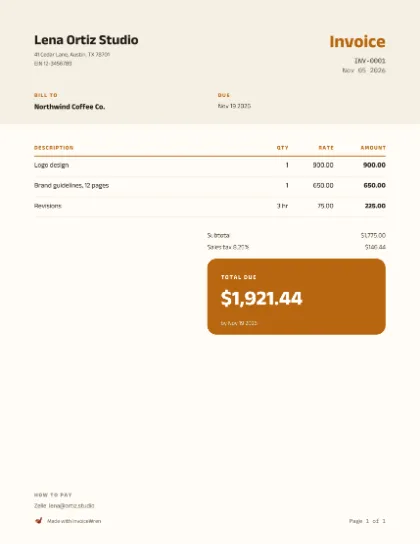
Duo
Cleaners and home services
-
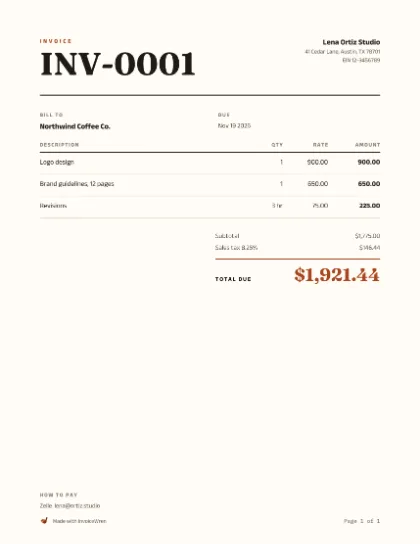
Editorial
Coaches and authors
07 / Rules by place
What the rules say about stage payments
Stage payments are shaped by state contract rules, and sometimes by the contract itself. Here is what the pages we read say.
| Place | What it says |
|---|---|
| California | On a home improvement contract, the down payment must not exceed $1,000 or 10 percent of the contract amount, whichever is less. Other payments before completion need a schedule in dollars that refers to the work and materials. A contractor may not request or accept payment that exceeds the value of the work performed, except the down payment. In this guide’s example, 10 percent of $880.00 is $88.00, and the example job is not in California. [1] |
| New York | A home improvement contract must hold a schedule of progress payments in dollars that identifies the state of completion, and each amount must bear a reasonable relationship to the work, materials or expenses at the time. [2] For the construction contracts its prompt-payment law covers, an interim or final invoice is due not later than thirty days after approval. [4] |
| Florida | No down payment cap in the section we read. A residential contractor who takes more than 10 percent of the price first must apply for permits within 30 days and start within 90 days of the permits. [5] |
| Federal contracts | Retainage is a part of a payment held back until the work is done. On federal construction contracts, a contracting officer may retain up to 10 percent of a payment until satisfactory progress. [6] Private contracts follow their own terms and state law. |
| Other states | Check your state’s contractor licensing board and your contract. Many states limit a down payment, and many have prompt-payment rules. |
These are summaries of the pages we read, not a full checklist and not legal advice. Rules and limits change, so check the current official page before you issue a real invoice.
How other countries do it
Other countries have their own words. In the UK and Australia, they do it this way.
| Country | How they do it |
|---|---|
| United Kingdom | In England, Citizens Advice tells customers that paying in stages is a good idea, because problems can be fixed before the final payment, and not to agree to a deposit of more than 25 percent. This is advice to customers, not a legal limit. [8] |
| Australia | In Queensland, a progress request is a “payment claim”: a written request for payment that identifies the work, states the amount and asks for payment. Only one payment claim can be given for each reference date in the contract. [7] |
We left out India. We could not read an official page there about stage billing, so we say nothing about it.
08 / When one invoice is not the whole job
From the first estimate to the final payment
Stage billing is where a PDF and a spreadsheet get hard to keep straight. InvoiceWren keeps every stage on one job.
- Stages from the estimateBill a stage by a percent of the agreed total or by the quantities done. Each progress invoice shows the agreed total, what was billed before, this invoice and what is left.
- Pending changes are never billedA progress invoice bills agreed work only. A pending change joins the agreed total when your client approves it.
- A warning, nothing blockedIf invoices pass the agreed total, you get a warning and a suggestion to write a change order. The client page labels it “above the agreed amount”. Nothing is blocked.
- Each payment counted onceYour client taps “I’ve paid” and you confirm it. Nothing is marked paid by a click, and the final invoice subtracts the deposit and every earlier invoice.
09 / Sending it
What to say when you send a progress invoice
Keep it short. Name the stage, the amount, what is left and the due date. Here is an original example you can change.
Hi Alex,
The hallway is finished. Attached is invoice INV-2026-001 for stage 1.
It is for $320.00, due Nov 17 2026. After it, $560.00 of the $880.00 agreed total is left to bill. As the estimate says, your $200.00 deposit comes off the final invoice.
Please use the payment details on the invoice and put INV-2026-001 in the reference.
If you have a question about a charge, reply to this email and I will help.
Thank you,
Oak & Brush Painting
If a stage is disputed, go back to the schedule in the estimate and the date the stage was finished. If the invoice needs a fix, keep a record of the correction. Do not quietly overwrite the only copy of a document you already sent.
10 / Last look
Check these before you send the invoice
Use this list on your real progress invoice. It catches the common slips. It is not legal advice.
Your ticks reset when you reload this page.
11 / Questions
Questions about progress invoices
What is a progress invoice?
A progress invoice is an invoice for part of a job: the work done up to now, or one agreed stage. It is also called a partial invoice, a stage invoice or an interim invoice. A job billed in stages has a few of them, and a final invoice that closes it.
Is a partial invoice the same as a deposit invoice?
A deposit invoice is the first partial invoice: it asks for part of the price before the work. A progress invoice bills work that is done. The final invoice bills what is left. All three belong to one agreed price, and the later ones must subtract what was already paid.
How do I split a small job into stages?
Split it by finished parts that the client can see, such as a room, a day of work or a delivery. Write each stage and its amount in the estimate. This guide’s two-stage job is the hallway, $320.00, and the bedroom, $580.00, with a $20.00 agreed discount and a $200.00 deposit.
Do I subtract the deposit from every invoice?
Only where your agreement says. Some contracts credit the deposit on the first stage, and some credit it on the final invoice. Write it on the estimate. In this guide’s job the deposit is credited on the final invoice, so stage 1 is billed in full and the final subtracts the $200.00. Whichever way you choose, credit it once.
How much deposit can I ask for?
The limits differ by state, and the estimate guide goes through them. For stage billing, remember that California bars a contractor from asking for or accepting payment above the value of the work done, apart from the down payment. [1] Write where the deposit is credited, and credit it once.
Can I bill for work I have not done yet?
In some places you cannot. California says that, apart from a down payment, a contractor may neither request nor accept payment that exceeds the value of the work performed or material delivered. [1] New York says progress payments must bear a reasonable relationship to the work, materials and expenses at the time of payment. [2] Bill what is done.
What if my invoices add up to more than the agreed total?
Stop and check. If the client asked for more work, write a change order and get a yes first. If you simply billed too much, correct it before you send it. InvoiceWren warns you when invoices pass the agreed total, and suggests a change order, but it does not block you.
How soon must a progress invoice be paid?
Use the due date in your agreement. For the construction contracts it covers, New York’s prompt-payment law says an interim or final invoice is due not later than thirty days after the owner approves it, and the owner must approve or disapprove it within twelve business days. [4] Other states have their own rules.
What is retainage?
Retainage is a part of each payment that the owner holds back until the work is finished. It comes from the contract and from state or federal law. For example, a federal construction clause lets the contracting officer retain up to 10 percent of a payment until satisfactory progress is achieved. [6] InvoiceWren has no retainage line. If your contract holds one back, name it on the invoice and track it yourself.
Do I bill by percent complete or by the work done?
Both work. A percent is fast for a job with one big task. Quantities, such as 3.5 of 9.5 hours or one of two rooms, are easier to defend. A schedule of values lists each part of the job with its value, what is done, and what is left. [3] InvoiceWren lets you bill a stage by percent of the agreed total or by line quantities.
Can I make a progress invoice for free?
Yes. The free invoice generator makes a PDF invoice with your lines and your payment details. It has no stage fields, so name the stage in each line. See what it does on this page.
12 / Sources
Sources and further reading
Official guidance, checked on Nov 07 2026. The worked invoice, reconciliation, checker, message and checklist are original teaching examples. Check the current rules before you issue a real invoice.
- California CSLB — License Law and Reference Book, 2026 edition (Business and Professions Code 7159 and 7159.5)California, home improvement contracts: the down payment is limited to the lesser of $1,000 or 10 percent of the contract amount; payments before completion need a schedule in dollars that references the work; and a contractor may not request or accept payment that exceeds the value of the work performed, except a down payment. The statute text is the board’s own PDF, because the state’s statute site does not serve scripts.
- New York General Business Law § 771 — Contract provisionsNew York: a schedule of progress payments in dollars that identifies the state of completion, and amounts that bear a reasonable relationship to the work, materials or expenses at the time of payment. The page shows the revision of Oct 29 2021.
- AIA Contract Documents — How to complete the G702 payment application and G703 continuation sheetThe industry-standard idea of a payment application: the contract sum, approved change orders, completed and stored work, previous payments and the current payment, supported by a schedule of values with work completed from previous applications, this period, and the balance to finish. The page has no date. Used for the idea only; it is the vendor’s guide, not the form.
- New York General Business Law § 756-a — Obligations (construction contracts)New York: an interim or final invoice is due not later than thirty days after approval, and the owner must approve or disapprove within twelve business days, for the contracts the article covers. The page shows the revision of Nov 26 2023.
- Florida Statutes 489.126 — Moneys received by contractorsFlorida’s permit and start deadlines for a residential contractor who takes more than 10 percent of the contract price as the first payment. 2025 statutes.
- Acquisition.gov — FAR 52.232-5, Payments under fixed-price construction contractsAn example of retainage in federal construction contracts: the contracting officer may retain up to 10 percent of a payment until satisfactory progress is achieved. Federal contracts only; private contracts follow their own terms and state law.
- Queensland Building and Construction Commission — Request paymentQueensland, Australia: under the Building Industry Fairness (Security of Payment) Act 2017, a payment claim is a written request for payment that identifies the work, states the amount and asks for payment, and only one claim can be given for each reference date. Reviewed Aug 31 2021.
- Citizens Advice (England) — Before you get work done on your homeEngland: paying in stages is advice to customers, and so is keeping a deposit low (the page says not to agree to more than 25 percent). Advice, not statute.
Bill the stage. Subtract what was paid.
Name the stage, check the schedule, take off the deposit once and show what is left. Then download a PDF that is ready to send. Running bigger jobs with deposits and changes? Keep every step connected in the app.
Free tools and templates
Make the document this guide talks about. No sign-up.
More guides
- How to make an invoice
- How to Write an Estimate
- How to Write a Change Order
- How to Make a Receipt
- What to include on an invoice
- How to number your invoices
- Best free invoice apps (2026)
- Change order template for a small remodel
- How to write a deposit invoice (with a worked example)
- Estimate vs invoice: what is the difference?
- How to set and word late fees
- A five-step schedule for late invoices
- Net 30 and other payment terms, explained
- Payment reminder messages you can copy
- Progress billing for contractors
- Taking deposits as a photographer
- What to do when a client will not pay
Invoice templates by trade
Sample lines and answers for each kind of work.
