Plumbing Invoice Template
A clear invoice for every plumbing job. Add the work completed, parts, service charges and payment details, then download your PDF.
Say who it's for
Everything you type stays in this browser. We never see it.
About you
About your client
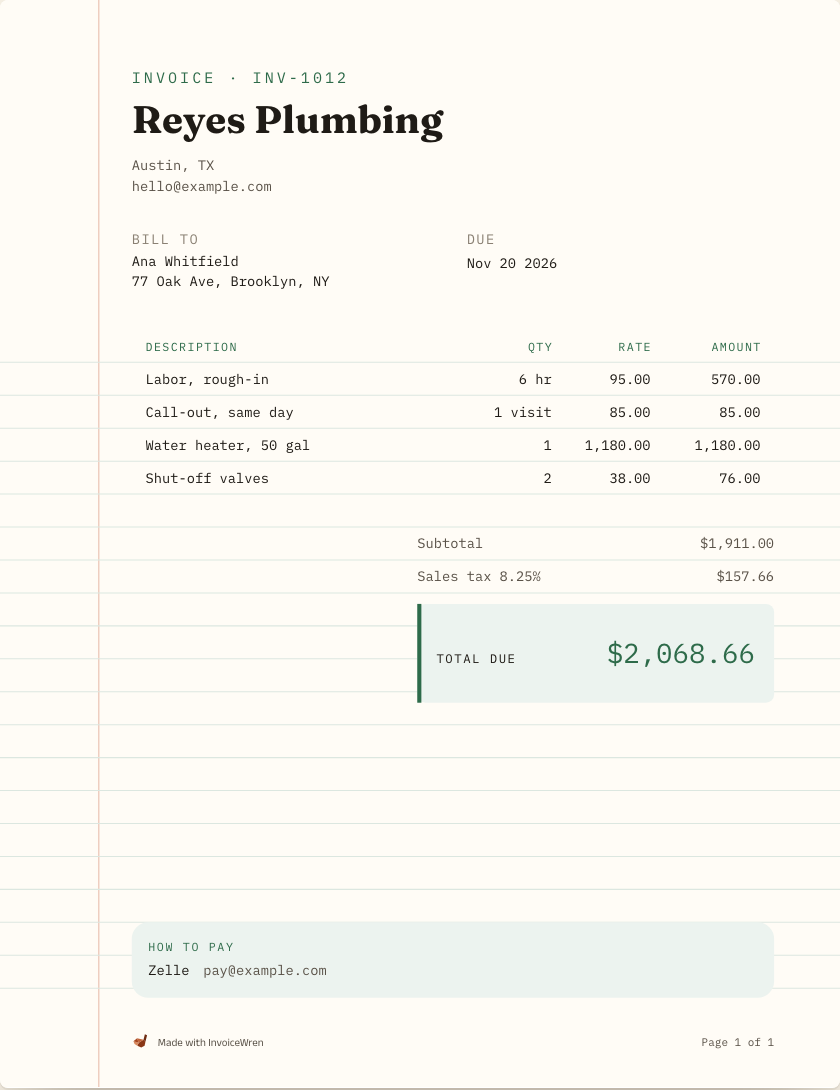
A sample plumbing invoice
Example figures only. Set your own rates.
What plumbing invoices commonly include
Tick off what you have put on your plumbing invoice. Include what applies to your job. Ticks stay in this browser.
How plumbers charge for repairs and installations
Plumbers commonly charge either an agreed fixed price for a defined repair or an hourly rate for work whose scope is uncertain. A service-call or diagnostic fee may cover dispatch and initial troubleshooting. Explain what the initial fee includes, whether additional labor is charged separately and whether the fee is credited toward an approved repair. Avoid charging twice for the same work.
Predictable jobs such as replacing a faucet, clearing an accessible drain or installing a specified fixture may use a fixed price. Describe the work included, and state whether ordinary parts, materials and cleanup are included. For hourly work, record the billable time and agreed rate. Significant replacement parts can be identified by type, quantity and customer-facing price when the agreement calls for itemized billing.
Water-heater installations and larger plumbing projects may use deposits, agreed milestones or a final payment after the contracted work is completed. Record installed equipment details, including the manufacturer, model, serial number and installation date. Permit and inspection requirements depend on the actual scope and jurisdiction. Charge separately for permit fees, old-equipment removal or additional work only when the agreement permits it.
Emergency or after-hours plumbing services may have a disclosed dispatch premium or higher labor rate. Explain which charges cover the emergency response and which cover the repair. In New York City, qualifying emergency work can also involve special permit-notification and follow-up filing requirements. An emergency invoice does not replace those obligations.
Tax treatment depends on the type of plumbing work. New York generally taxes the full customer charge for taxable repairs, including labor, materials and related markups. Qualifying capital improvements, including certain permanent water-heater installations, are treated differently. For qualifying work, retain the appropriate capital-improvement documentation, including Form ST-124 where applicable, instead of assuming that separately listed materials are the only taxable items.
What the price depends on
- Fixed price
- For a defined repair. Predictable jobs such as replacing a faucet or clearing an accessible drain often use one. Say what is included.
- Hourly rate
- For work whose scope is uncertain. Record the billable time and the agreed rate.
- Service-call fee
- May cover dispatch and initial troubleshooting. Say what it includes and whether it is credited toward an approved repair.
Questions people ask
What should a plumbing invoice include?
Include your plumbing business name, contact details, invoice number, invoice date, customer name and service address. Describe the completed work, service date, labor or fixed-price charges, parts and applicable taxes. Show any agreed callout fees, deposits, credits, total due, payment terms and payment instructions. Include the applicable licensed-plumber identification and permit references where relevant.
Should plumbers charge by the hour or a flat rate?
Both methods are used. Fixed prices are useful for well-defined repairs or installations, while hourly billing may suit uncertain troubleshooting or work with variable scope. Use the pricing method agreed with the customer and make clear which labor, parts and services are included. Do not charge separate hourly labor again when it is already included in a fixed repair price.
How do I charge a plumbing service-call fee?
Explain whether the callout fee covers dispatch, travel, initial diagnosis or a specified amount of labor. If the fee is additional to the repair, disclose that arrangement. If it is credited toward an approved repair, show the credit on the invoice. Avoid collecting twice for the same service.
How do I invoice plumbing diagnostics when no repair is performed?
Describe the reported problem, diagnostic work completed and agreed fee. Record any findings that were actually established. If a repair is recommended but declined, keep the proposed repair price in an estimate rather than invoicing it as completed work.
Should plumbing parts and labor appear on separate lines?
Follow the agreed pricing method. A fixed-price repair may already include standard parts and labor, while an hourly or time-and-materials agreement may itemize them separately. Identify significant supplied components when helpful, but do not charge again for materials included in an agreed package. Separating invoice lines does not by itself determine sales-tax treatment.
Can plumbers add a markup to replacement parts?
The customer-facing material price can include an agreed markup or sourcing charge, subject to the contract and applicable rules. Make the pricing arrangement clear. If the agreement requires billing at actual purchase cost, follow that requirement. Do not describe a marked-up amount as the supplier's original receipt price.
How do I invoice a drain-cleaning job?
Identify the affected drain or fixture, the completed service and the agreed price. Distinguish basic drain clearing from additional work such as camera inspection, pipe repair or extensive blockage removal. If further work is recommended but not authorized, show it in an estimate rather than billing it as completed.
How do I invoice a plumbing leak repair?
Describe the affected fixture or piping location, the problem identified and the repair performed. List significant replacement components and agreed labor charges. Document relevant tests or checks actually completed. If hidden damage requires additional work, obtain the approval required by the agreement before adding those charges.
What should a water-heater installation invoice include?
Identify the installed water heater, including its manufacturer, model, serial number, capacity and installation date. Describe the agreed installation work and identify any separately authorized connections, removal or disposal. Record relevant permit or inspection references when applicable. Apply deposits or previous payments and distinguish the installed-equipment warranty from any separate workmanship warranty.
Is repairing a water heater taxed differently from installing one in New York?
It can be. New York's Department of Taxation and Finance identifies installing a hot-water heater as an example of a qualifying capital improvement, while replacing a water-heater thermostat is an example of taxable repair work. Capital-improvement treatment depends on the actual project meeting the required conditions and appropriate documentation. Do not apply the same tax treatment to every water-heater job.
Do plumbers charge sales tax on labor in New York?
Generally, yes, when the work is a taxable real-property repair, maintenance or installation service. New York generally taxes the full customer charge for these services, including labor, materials, expenses and markups. Qualifying capital improvements are treated differently. Determine the work classification before calculating tax rather than assuming that labor is exempt.
What is Form ST-124 for plumbing work?
Form ST-124 is New York's Certificate of Capital Improvement. A customer should provide a properly completed certificate when the work qualifies, and the contractor should retain it as supporting documentation. It helps establish why sales tax was not collected from the customer. The certificate does not make an otherwise taxable repair a capital improvement or allow contractors to buy ordinary building materials tax-free.
Does a plumber need a license in Brooklyn, New York?
New York City requires a Licensed Master Plumber for regulated plumbing work and its permitting processes, subject to specific exceptions for minor work. Plumbing work may be performed by appropriately supervised employees under the licensed business. NYC also prescribes identifying information for master-plumber business advertising, websites, vehicles and stationery. Verify the responsible licensed business and the actual work requirements.
Where should my NYC plumbing license number go?
Provide a clearly visible business or license-information area that identifies the responsible Licensed Master Plumber. NYC's business identification rules address the licensee's full name, prescribed licensed-plumber wording, license number, business address and trade-name presentation on specified business materials. A generic license-number box alone does not establish compliance with every applicable document requirement.
Does every plumbing repair require a permit in NYC?
No. NYC distinguishes certain minor fixture replacements and ordinary repairs from plumbing work requiring permits. Some work may require a Licensed Master Plumber even when a separate permit is not required. More extensive pipe alterations, equipment changes and other regulated work may require a Limited Alteration Application or another filing. Check the actual scope before issuing or charging for a permit.
Does replacing a water heater need a permit in NYC?
Requirements depend on the type of water heater, building and work involved. NYC has separate ordinary-plumbing-work and Limited Alteration Application procedures for qualifying equipment replacement. Gas and electrical work can trigger additional requirements. The contractor should identify the applicable filing, permit or reporting procedure rather than assuming every replacement is exempt.
How do I invoice a plumbing emergency?
Describe the emergency condition, service date, response work and completed repair. Itemize any agreed emergency dispatch premium or higher labor rate so the customer understands the charges. Do not add both an overlapping emergency fee and another charge for the same time without an agreed basis. Follow any required NYC emergency work notifications or permit filings separately.
How do I invoice a plumbing repair that requires additional work?
Record the additional problem, proposed scope, price and any schedule impact. Obtain the approval required by the contract and applicable law before billing new work. Reference the approved estimate change or change order on the final invoice. Do not charge for proposed repairs that the customer declined.
Can I charge separately for plumbing permits and inspections?
Yes, when the charge is applicable and permitted by the agreement. Identify actual government permit or inspection fees separately from any contractor administrative charge. Keep the filing reference when one exists. Do not charge a fictitious permit fee or imply that paying a fee means a final inspection passed.
Should I include a warranty on a plumbing invoice?
Record the actual manufacturer's warranty for installed equipment or parts and refer to any separately agreed plumbing workmanship warranty. For appliances such as water heaters, retain the model, serial number and installation date. Do not promise a universal warranty term or suggest that manufacturer coverage automatically pays for labor.
How do I invoice a plumbing warranty callback?
Reference the original job and describe the issue and return work. Apply the actual warranty coverage, showing a credit or zero charge when appropriate. If the new work is outside the warranty, explain the scope and obtain authorization before charging for it.
When should a plumbing invoice be paid?
Follow the terms agreed with the customer and applicable law. A small service repair may be payable on completion, while a larger installation may have deposits or milestone payments. Show payments already received, the balance outstanding and the payment due date.
What if the customer supplies the plumbing fixture?
Bill the agreed labor and contractor-supplied parts rather than charging again for the customer's own fixture. Identify any additional fittings actually supplied. If the provided fixture is incompatible or requires unexpected work, explain the new scope and price and follow the approval process before adding charges.
Get it as a file
These open our general invoice templates. They are not pre-filled with plumbing items. For a PDF with your plumbing lines, fill in the form above.
Quoting the job first? Use the estimate generator. Want a different look? Try the invoice builder. New to invoicing? Read how to make an invoice, what to include on an invoice and how to number your invoices.
Related trades
Other invoice templates you may need.